 Menu
A warehouse can have room for its occupier to grow and still lack the electrical capacity for the next operation. Electric trucks, automation, refrigeration and electric heating change not just how much power a site needs, but when it needs it.
That makes power a property decision. The question is no longer simply what the building can support today, but what it must support when the customer grows.
A pathway to power links the future operating requirement to capacity available now, the time needed to deliver more and the point at which capital should be committed. The aim is to prepare early without buying capacity before it is justified.
Start with the operation and the date
Consider a tenant planning to introduce electric trucks over the next two years. The yard has space for the vehicles and the building suits the operation. What has not been established is whether the site can supply the power needed to charge them on time.
The fleet team may wait for vehicle orders before confirming demand. The owner may wait for a formal request before investigating an upgrade. Meanwhile, network assessment, design, permits and construction take time. If that work exceeds the time remaining, neither party is ready.
The result could be temporary charging, changes to fleet operations, urgent expenditure or a delayed transition. These are commercial consequences of making the power decision too late.
Start with the actual operation: vehicle numbers, energy required, arrival and departure windows, and the consequences of missed departures. For other uses, capture the equivalent operating constraints. Then establish the date capacity is needed and how firm the requirement is.
Work backwards from that date. Map the activities that drive delivery time, their dependencies and a sensible allowance for uncertainty. This gives the team a latest sensible start date—a point after which waiting for greater certainty starts to threaten the operating plan.
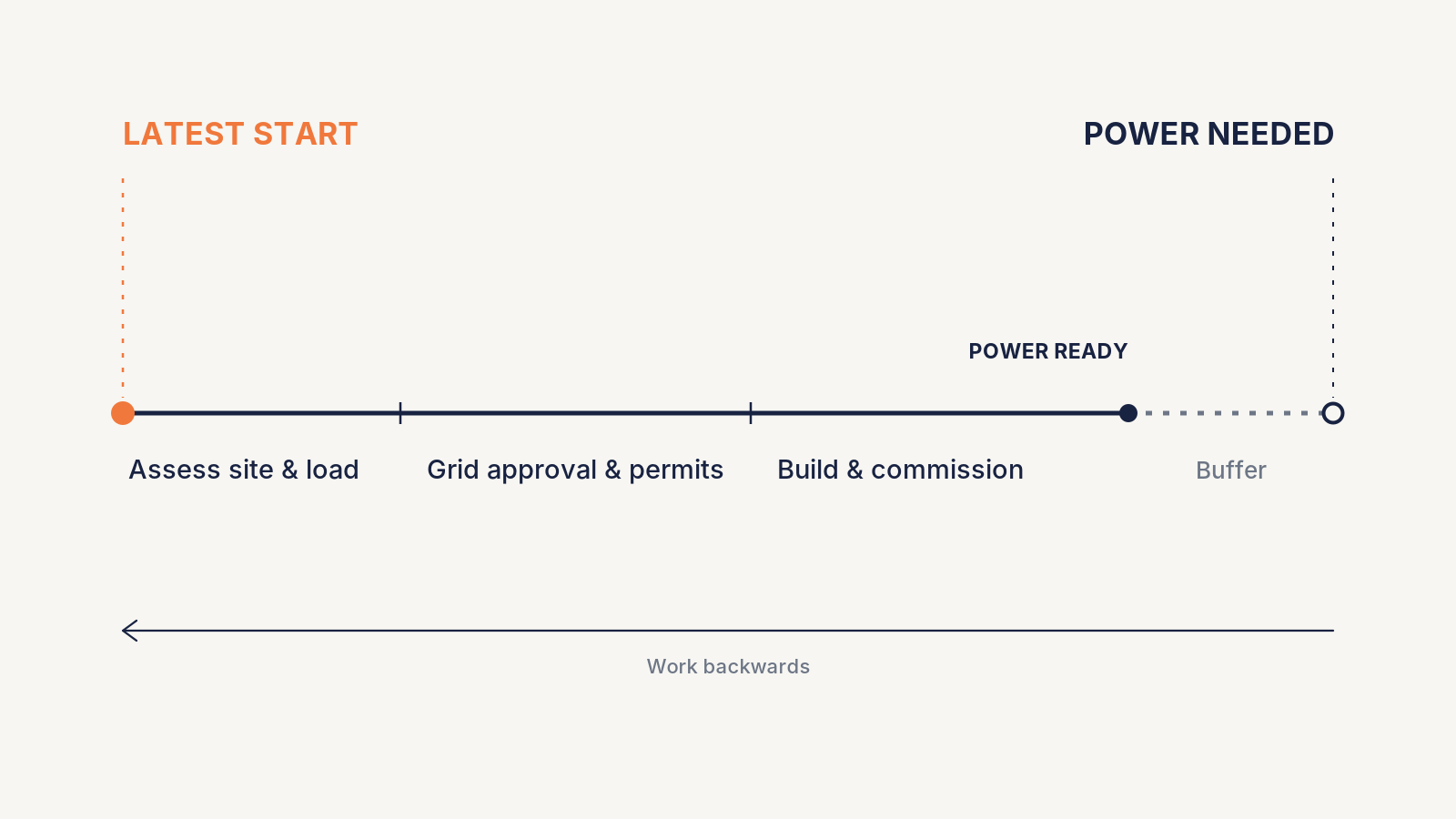
JLL's research places power availability within property feasibility and value. For logistics owners, that is a reason to bring future operating needs into the asset plan before they become urgent.
Find the constraint before choosing equipment
An annual electricity bill shows how much energy was used, not whether the next operation can run. Energy, measured in kilowatt-hours, is the amount used over time. Power, measured in kilowatts, is the rate at which it is needed. The timing of demand matters as much as its annual total.
The limit may sit in the network connection, the site's electrical equipment or the way demand is concentrated during the day. These are different problems, even when they all appear as “not enough power”. More than one can apply.
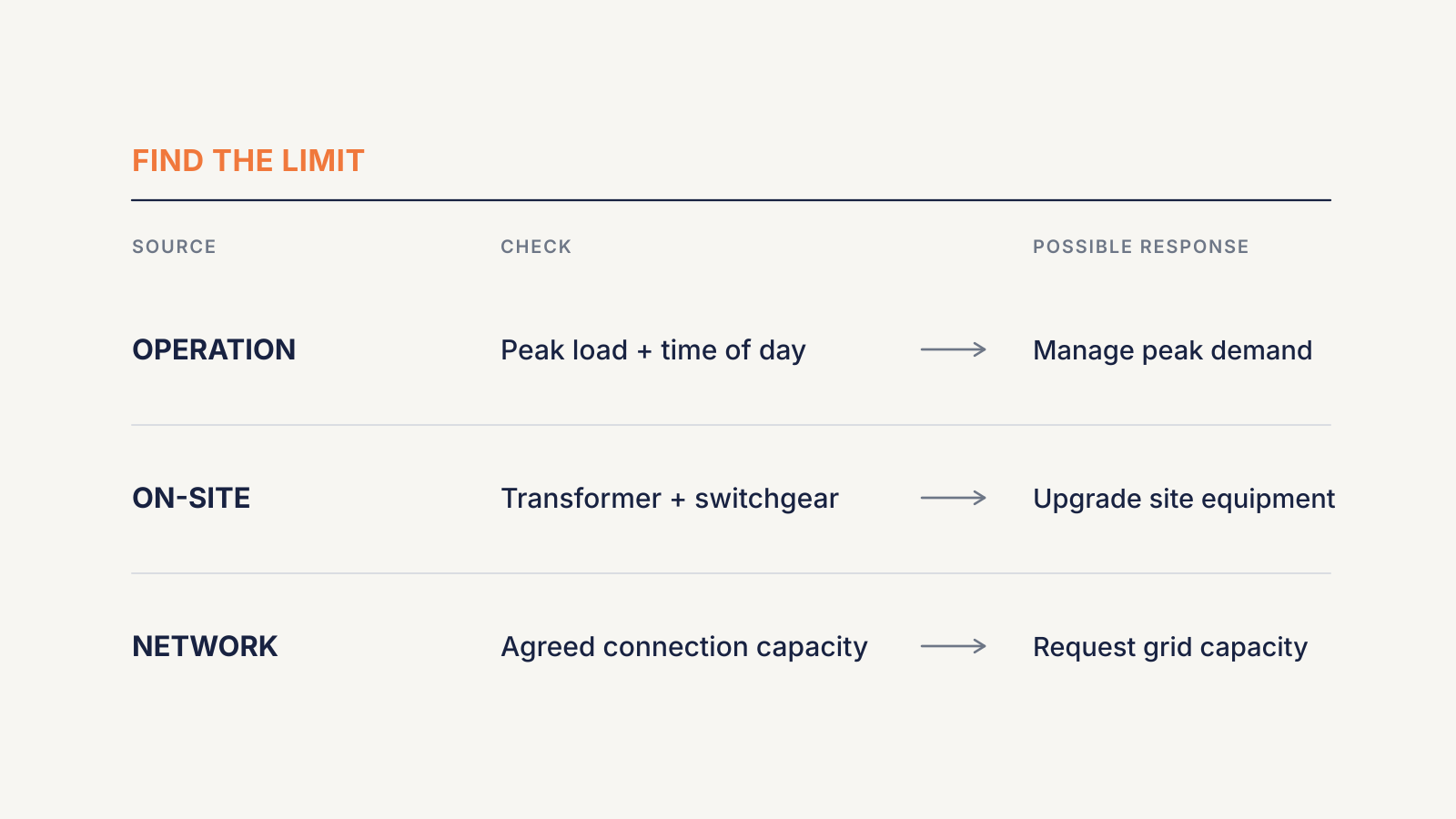
A larger transformer cannot create upstream network capacity. A higher connection allowance does not prove that switchgear and cabling can carry the load safely. And moving demand to a different hour only works if the operation can tolerate it.
Compare the required power profile with the site's electrical limits and connection conditions before selecting equipment. Managed charging, storage and local generation may help, but none removes the need to understand the physical constraint.
A lower charging peak is not useful if trucks miss their departure. Storage has finite power and energy. Solar generation may not coincide with the hours of highest demand.
ElaadNL's mobility research illustrates how flexible charging can help use constrained networks. The IEA also describes better use of existing grids as a complement to expansion. Neither source establishes which solution will work at a particular warehouse. That requires a site assessment.
Match the commitment to the evidence
A customer ambition, an approved budget and an equipment order carry different levels of confidence. The owner's response should reflect that evidence alongside the lead time of any proposed solution.
Before deciding where to spend, establish the required load and date, the capacity available today, the options for closing the gap and the commercial case for each.
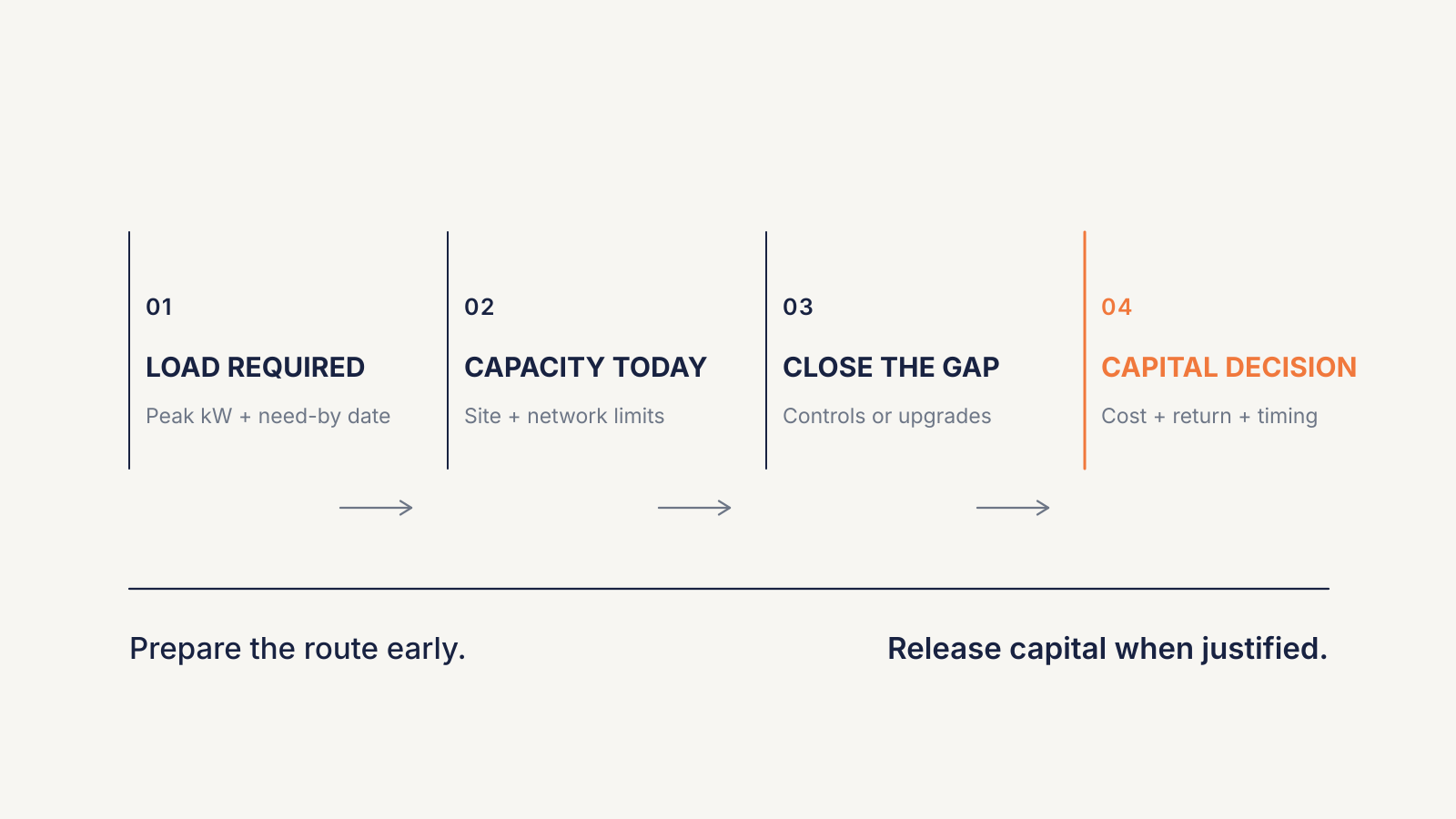
Then separate preparation from the larger capital commitment:
- InvestigateAssess existing capacity, the network position and credible demand scenarios. Record what remains uncertain.
- PrepareAdvance design, network engagement, permits or space allocation where waiting would threaten delivery. Understand the cost and obligations of each step.
- CommitApprove equipment and works when expected demand, the commercial case and the delivery date justify it. Agree who pays, owns and operates the assets.
These are judgement calls, not automatic approval gates. A long network lead time can justify an early commitment; design and preparation can also involve real cost and risk.
For the hypothetical warehouse, overnight charging might support the first vehicles. A larger fleet or shorter turnaround could require more capacity later. The plan should show what works in each phase—and the latest date for deciding on an upgrade.
Update it when the customer's requirements or the network position change. A route that only works if every assumption holds is not much of an option.
Balance the cost of acting early and late
Phasing expenditure can avoid installing capacity before it is used. But it can also mean repeated construction, expensive temporary equipment or a customer operating date that cannot be met.
Both risks belong in the same investment decision.
- Investing earlyCapital tied up, unused capacity, ongoing costs and the risk that requirements change.
- Investing lateDelayed operations, interim costs, repeat works and the risk that a viable supply route arrives too late.
Lease duration, customer commitment, alternative uses for the infrastructure and the allocation of cost and risk all influence that judgement. The lowest upfront spend is not necessarily the best value.
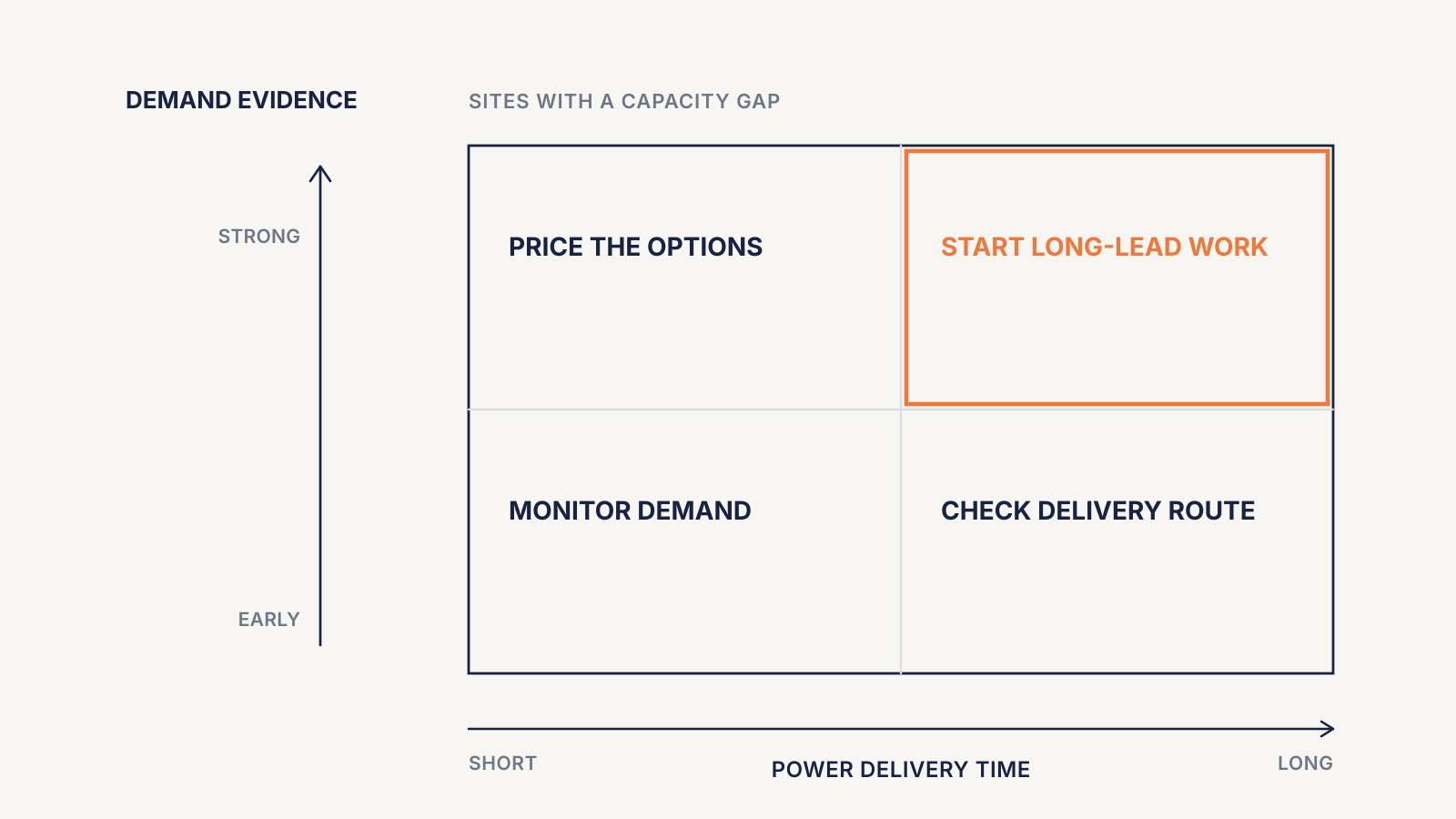
Across a portfolio, use a consistent method to decide which sites need attention first. Demand confidence and delivery lead time are more useful than a uniform installation target.
Leave the meeting with a decision record
The occupier understands the operation. The owner understands the building and investment plan. The network operator establishes supply options and conditions. Their inputs belong in one decision record, not three separate timelines.
Five questions make the next review more useful:
- What must this property support, by when, and how certain is that need?
- What power can the site and its connection deliver under the required operating conditions?
- Which capacity gap remains after acceptable changes to the operation?
- Which action must start next, who owns it, and when does delay become critical?
- What evidence justifies the next capital commitment, and who carries the risk if demand changes?
Record the next action, owner, decision date, cost, dependencies and investment trigger. Revisit the record when the requirement or delivery assumptions change.
Standardise the method, not the solution
Across multiple sites, repeated assessments, specifications and purchasing can slow delivery. Sharing that work makes the programme more efficient while keeping network, customer and commercial decisions specific to each property.
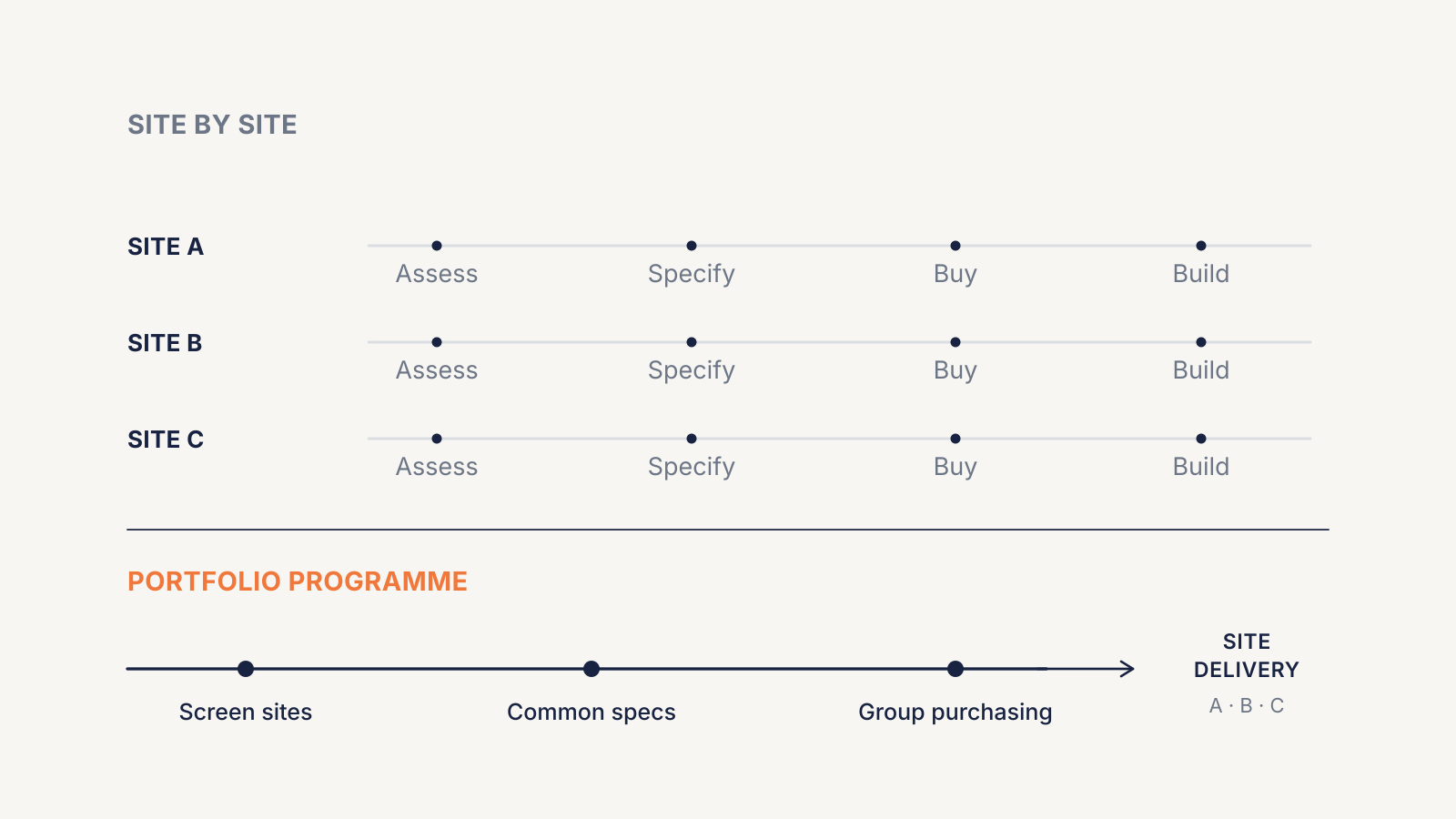
The value of a pathway to power is clarity about what must happen next, and when. Prepare before demand arrives, but commit capital when the evidence and delivery risk justify it.
Where does the next power decision sit in your asset plan—and who owns it?
The warehouse example is hypothetical. The decision framework is my interpretation for logistics property planning. The linked research provides market context; it does not establish a site's technical feasibility, connection date or investment return.